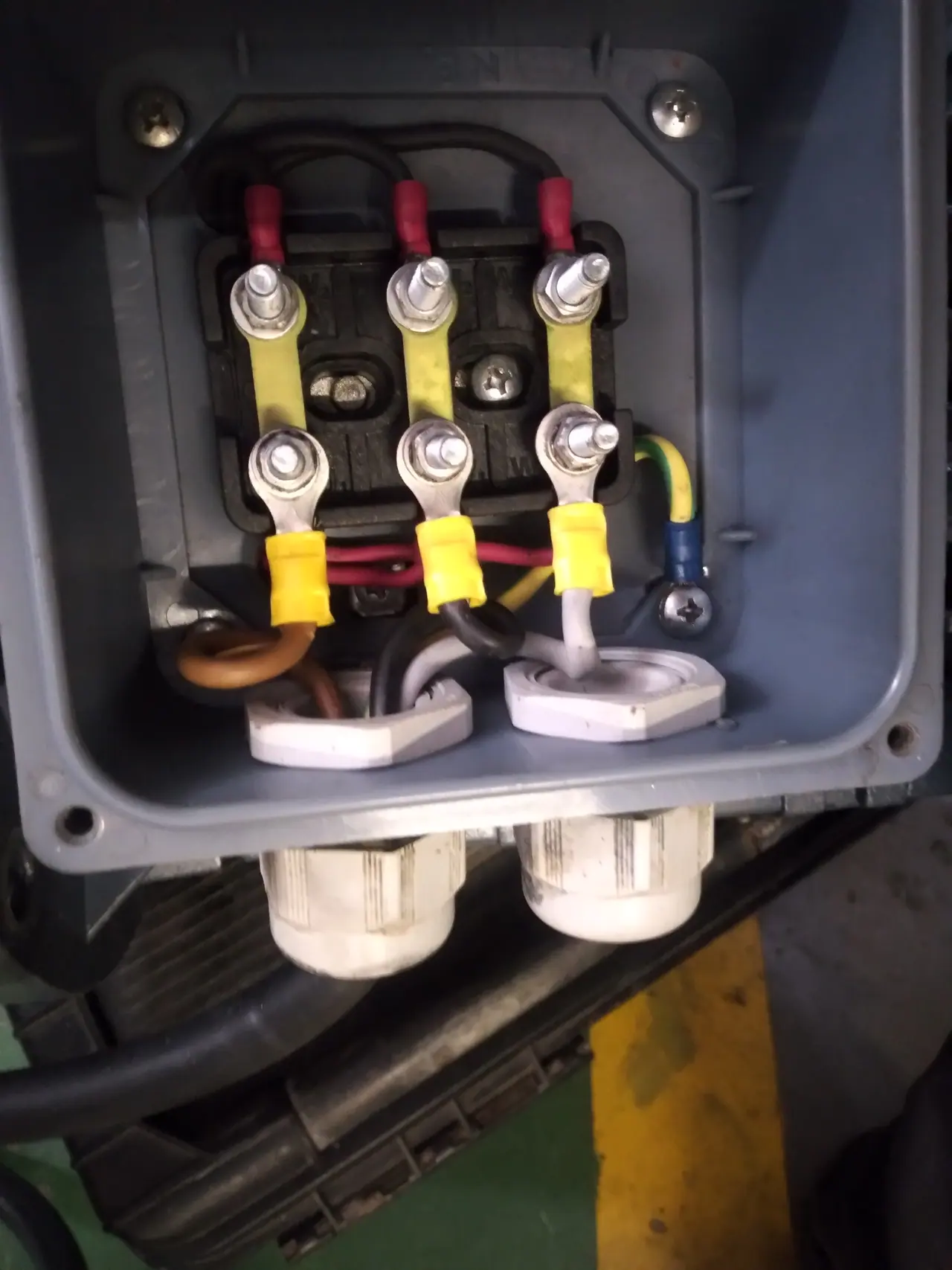
A three-phase motor has three windings. In star, one end of each winding is joined together at a common point, so each winding receives a lower phase voltage. In delta, the windings are connected end-to-end in a triangle, so each winding receives the full line voltage. The same motor behaves differently because the winding voltage has changed.
 FixakitchenMotor control field notes
Motor control science
Star-delta motor connection, wiring and starting current
Star-delta starting is used on larger three-phase motors to reduce the heavy current drawn at start-up. It matters on equipment with big pumps, fans, compressors and wash motors because the motor is not only a mechanical part. It is an electrical load with windings, impedance, magnetic fields and torque that all change during starting.
Quick answer
How does a star-delta motor connection work?
The starter first connects the motor windings in star so each winding receives line voltage divided by the square root of three. Once the motor accelerates, the star contactor opens and the delta contactor closes, applying full line voltage across each winding for normal running. The contactors must be mechanically and electrically interlocked so star and delta cannot close together.
The copper winding has resistance, but an AC motor is not diagnosed by resistance alone. At start-up the motor also has inductive reactance and back EMF. Before the rotor is spinning properly, back EMF is low, so the motor can draw a very high inrush current. The real opposition to AC current is impedance: resistance plus reactance.
In star connection, each winding sees about 58 percent of the normal delta winding voltage. Because current follows voltage through the motor impedance, the starting current drops heavily. This protects fuses, breakers, contactors, cables and the site electrical supply from the shock of a large motor starting directly in delta.
Reducing current is useful, but it has a trade-off. Motor torque is strongly linked to voltage, so star starting gives much less starting torque than delta. That is why star-delta is suitable only where the motor can begin with a light load or where the load does not need full torque immediately.
A star-delta starter uses contactors and a timer or controller. The main and star contactors energise first so the motor accelerates gently. After a delay, the star contactor opens, a short pause prevents a short circuit, and the delta contactor closes for normal running. If that timing is wrong, the motor can trip, bang mechanically or damage contacts.
A motor that trips on changeover may have a wiring error, weak supply, worn contactor, bad timer, incorrect overload setting, mechanical load problem, winding fault or poor terminal connection. Measuring only one resistance value is not enough. The technician must understand the circuit state, current path, load condition and voltage at each stage.
Fault diagnosis
Why a star-delta motor trips on changeover
Common causes include incorrect motor terminal links, reversed winding ends, overlapping contactors, a failed timer, burnt contacts, low supply voltage, an incorrect overload setting, a winding fault or a mechanical load that has not accelerated sufficiently in star.
Before testingConfirm the motor nameplate supports the site voltage and star-delta operation
Electrical checksSupply balance, winding identification, contactor sequence, timer and overload
Mechanical checksShaft condition, driven load, acceleration time and transition behaviour
Repair notes signup
Get more motor control notes
Sign up and Fixakitchen can send practical field notes on three-phase motors, contactors, overloads, pumps, fans, compressors and electrical diagnosis on commercial equipment.