A relay coil needs a stable voltage to pull its contacts in cleanly. If the supply neutral is loose, the control circuit can see a floating or unstable reference. That can make a relay chatter, buzz or drop in and out under load. The relay may be damaged by the vibration and arcing, but the root cause can still be upstream in the supply or neutral path.
 FixakitchenCommercial dishwasher field notes
Tunnel dishwasher diagnosis
Hobart relay noise, tripping and the loose neutral fault
On this Hobart tunnel dishwasher, the relay was very noisy and was replaced. Later diagnosis showed the more important fault: a loose neutral. On large machines like this, diagnostics are not as simple as hearing one bad relay and changing one part. The electrical supply, sensors, boiler circuits and PCB inputs all have to agree before the machine can run reliably.
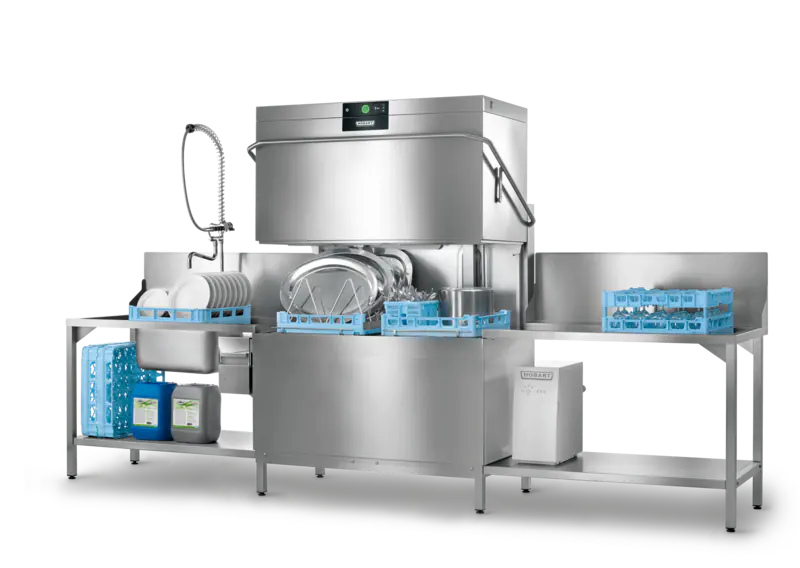
A commercial dishwasher uses contactors, pumps, heaters, solenoids, sensors and a PCB at the same time. A loose neutral can create voltage imbalance, intermittent control power and false sensor readings. The PCB may interpret that as a real fault and stop the machine to protect the heaters, pumps and wash process.
Tunnel dishwashers normally manage a heated wash tank and a final rinse or booster boiler. The wash section keeps detergent water hot enough to break down grease and food soil. The final rinse boiler raises clean incoming water to sanitising temperature and helps flash-dry dishes. If either temperature circuit is unstable, the machine can fail hygiene, timing or safety checks.
The control PCB watches temperature probes, water level devices, door or hood switches, pump feedback, heater contactors and sometimes pressure, flow or chemical dosing signals. These inputs are scientific measurements, not guesses. A bad reading can come from the sensor, wiring, connector, power supply, neutral reference or the process itself, so each signal has to be tested against what the machine is physically doing.
Big warewashing machines operate as systems. Water temperature affects chemical action. Pump pressure affects wash quality. Boiler heating affects rinse sanitation. Electrical stability affects every control decision. A technician has to separate symptoms from causes, measure voltages under load and confirm wiring integrity before trusting the PCB fault history.
Replacing the noisy relay was useful, but the final repair logic had to include the loose neutral. If the neutral fault remained, another relay or PCB input fault could return. On tunnel dishwashers, the correct method is to prove the supply, then the control circuit, then the sensor data, and only then decide which parts are genuinely faulty.
Repair notes signup
Get more dishwasher diagnosis notes
Sign up and Fixakitchen can send practical field notes on commercial dishwashers, heating circuits, sensors and electrical fault finding.